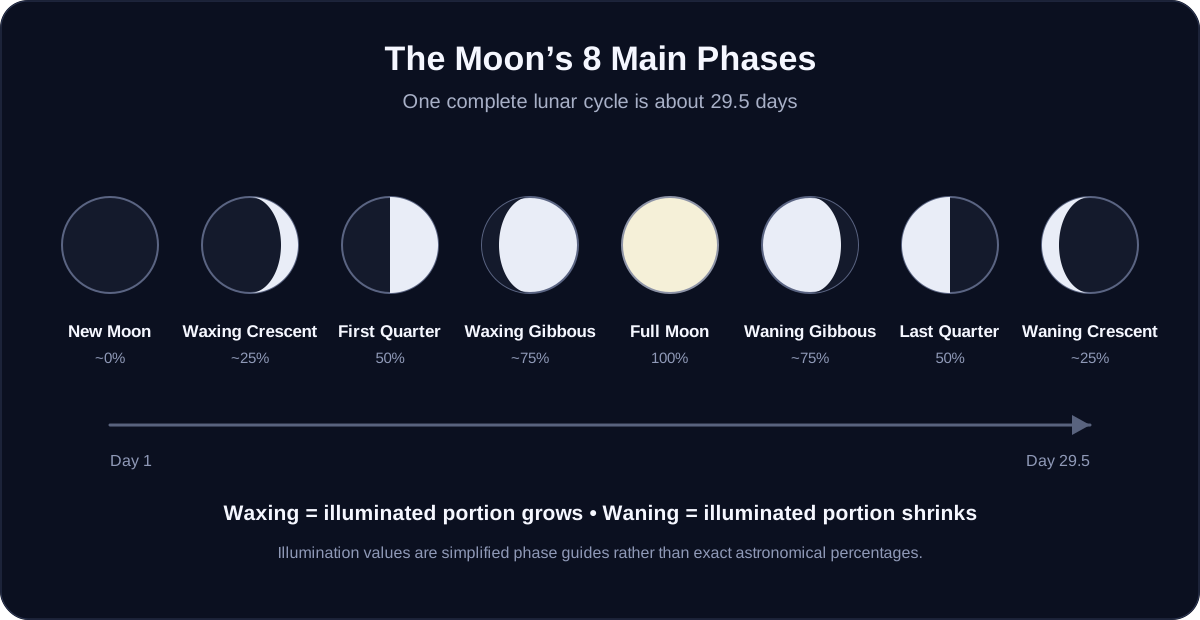
Check the approximate lunar phase for today or any date.
The page estimates where a selected date falls within the Moon's roughly 29.53-day synodic cycle, then maps that position to one of eight familiar phase bands. That makes it useful for a quick visual answer such as “waxing crescent” or “waning gibbous”. It is deliberately simpler than an astronomical ephemeris.
The percentages shown are rounded labels associated with the eight phase bands, not a precision calculation of the exact illuminated fraction at a particular second. Real illumination changes continuously. A date near the boundary between two bands can therefore look slightly different from a specialist astronomy service that calculates the Moon's exact geometry.
A photographer can compare a planned landscape shoot with the broad lunar phase, a camper can get a rough idea of whether nights will be darker or brighter, and a teacher can use the date selector to show how the cycle progresses over several weeks. For a whole month, the Moon Phase Calendar is easier to scan than checking dates one by one.
The phase alone does not provide moonrise, moonset, altitude, cloud cover or whether local terrain blocks the horizon. A full moon may be below your horizon at a particular time, while a crescent can be difficult to see even on a clear evening. For an actual observation session, pair the broad phase with location-specific rise and set times and a weather forecast.
Those dates are rough cycle estimates derived from the same simplified phase model. They are useful for orientation, not for scheduling an observation that depends on the exact astronomical instant. For telescope work, eclipses, tides, navigation or scientific use, confirm exact phase times with an authoritative astronomy source.